
Seongnam Dental
Without Dentures, Like Your Own Teeth
What Is a Full-Arch Implant?
A Guide by Dr. Park Hyun-seong & Dr. Park Hyun-jun
What Is a Full-Arch Implant?
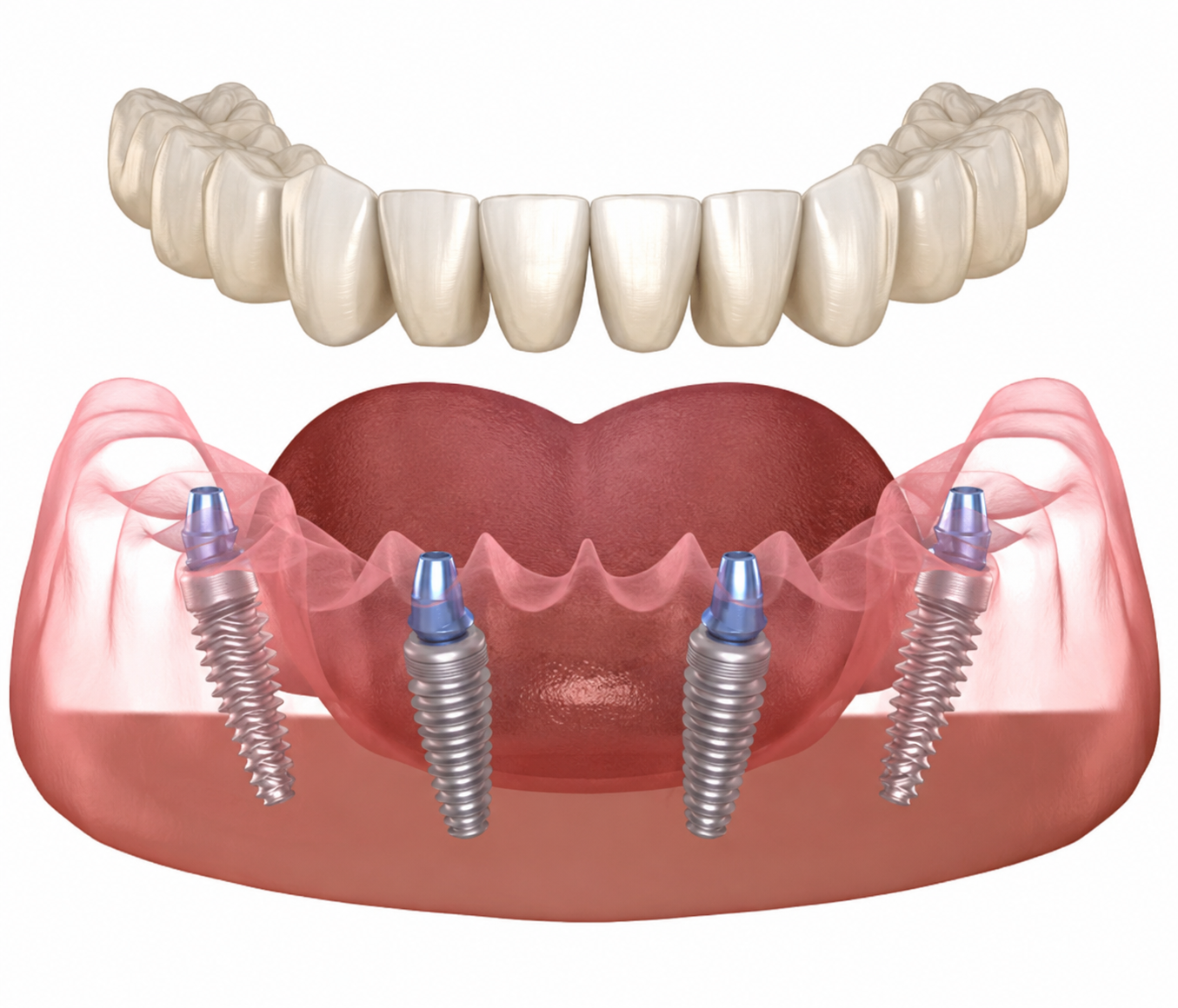
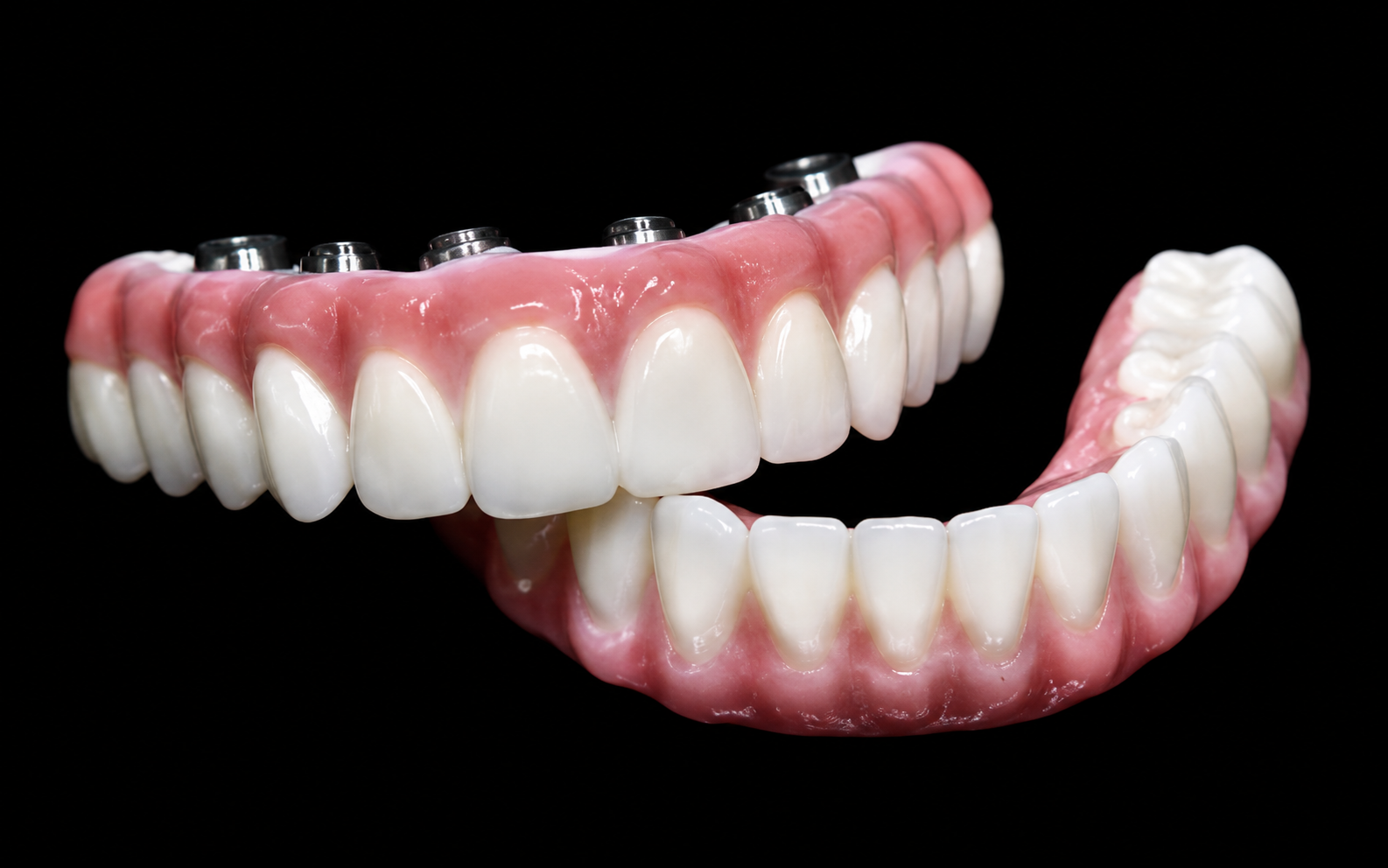
A fixed prosthetic treatment that supports an entire upper or lower arch using a minimum of 4–6 implant fixtures. Unlike dentures, no removal is needed, and chewing force and aesthetics approach those of natural teeth.
Fixed Prosthetics
Once the fixtures osseointegrate with the bone, the prosthesis is permanently fixed — no removal, no shifting. Oral hygiene maintenance follows the same routine as with standard implants.
Same-Day Temporary Prosthesis
With the All-on-4 technique, a temporary prosthesis can be fitted on the day of surgery, preserving aesthetics and function throughout treatment. Total treatment duration is typically 4–6 months.
Why Choose Full-Arch Implants?
For patients with edentulism (complete tooth loss) or extensive tooth loss, conventional dentures present fundamental limitations: reduced chewing force, discomfort, and accelerated bone resorption. Full-arch implants support an entire arch with just 4–6 fixtures, restoring the full dentition as a fixed prosthesis. Because the load is transferred directly to the bone, the rate of resorption slows significantly — and that is what sets them fundamentally apart from dentures, along with the recovery of near-natural chewing function, speech, and aesthetics.
Systemic Health Conditions to Confirm Before Full-Arch Implant Treatment
The success of full-arch implants depends as much on the patient’s overall health as on surgical skill. The first priority is blood glucose control. In patients with diabetes, an HbA1c above a certain threshold significantly raises the risk of osseointegration failure, so medical stabilization must precede surgery. Osteoporosis reduces bone density and affects initial fixture stability; patients on bisphosphonates in particular carry a risk of osteonecrosis of the jaw and must share their full medication history with the treating clinician. Smoking impairs blood supply and meaningfully increases implant failure rates — a smoking cessation period of at least two weeks before and after surgery is recommended. Patients on anticoagulant or antiplatelet therapy should coordinate the surgical schedule and any medication adjustments in advance. These systemic factors are not barriers to treatment but rather inform the fine-tuning of the treatment plan — even if health concerns exist, a consultation to assess individual suitability is always the right first step.
Is Full-Arch Treatment Possible with Insufficient Bone?
Even when bone grafting is deemed necessary, it can generally be performed simultaneously with fixture placement in most cases, minimizing the total number of visits and the overall treatment timeline. Grafting materials include autograft, allograft, xenograft, and synthetic bone substitutes; the material type and volume are determined individually based on resorption patterns and the implant site. A healing period for new bone formation follows grafting, during which Cone Beam CT is used to monitor bone development at each stage. Because the need for grafting and its scope are determined from a preliminary 3D analysis, it is important not to draw conclusions before a visit — a precise diagnosis first, then a treatment plan.
Method Comparison
Full-Arch Restoration Options at a Glance — Seongnam Dental
Dentures, individual implants, and full-arch implants differ in indication and long-term prognosis. The optimal approach depends on each patient’s condition.
| Category | Complete Denture | Individual Implants | Full-Arch Implants |
|---|---|---|---|
| Fixation Method | Gum suction | Per-tooth fixation | Fixture-fixed |
| Chewing Force | 20–25% of natural teeth | Comparable to natural teeth | Comparable to natural teeth |
| Bone Resorption Control | No inhibitory effect | Excellent | Excellent |
| Removal Required | Daily removal needed | Not required | Not required |
| Fixtures Needed | None | One per missing tooth | 4–6 per arch |
| Treatment Duration | Short | Long (for multiple missing teeth) | 4–6 months |
| Same-Day Temp Prosthesis | N/A | Case-dependent | Available with All-on-4 |
| Primary Indication | Immediate restoration needed | Partial tooth loss | Full arch or extensive loss |
Who Needs It?
Who We Recommend Full-Arch Implants For — Seongnam Dental
If any of the following conditions apply to you, full-arch implants may offer a more stable and functional solution.
🦷 Fully Edentulous or Nearly Toothless
Where all teeth in the upper or lower arch have been lost, or where multiple teeth have a poor prognosis and extraction is unavoidable, full-arch implants are the appropriate solution. Remaining teeth can be extracted and fixtures placed simultaneously in the same surgical session.
😣 Dentures That No Longer Fit Comfortably
If denture discomfort, pain, or instability makes daily eating difficult, or if gum resorption means dentures no longer fit properly, full-arch implants can restore a fixed prosthesis.
🔬 Looking for a More Efficient Alternative to Multiple Implants
Placing individual implants for each missing tooth in extensive loss cases carries a significant burden in terms of surgical sessions, time, and cost. The full-arch approach — supporting an entire arch with 4–6 fixtures — is far more efficient overall.
🦴 Hoping to Avoid Bone Grafting
The All-on-4 technique uses angled implant placement to maximize use of existing bone, expanding the range of cases treatable without grafting. Suitability is determined after a detailed Cone Beam CT analysis.
Procedure Flow
Full-Arch Implant Procedure — Seongnam Dental
From precise diagnosis to final prosthesis, each stage is carried out systematically.
Precise Diagnosis & Treatment Planning
Cone Beam CT provides a three-dimensional analysis of upper and lower arch bone volume, density, and anatomy. Residual tooth prognosis, occlusal analysis, and systemic health status are combined to determine the optimal approach — All-on-4 or All-on-6.
Extraction of Remaining Teeth & Fixture Placement
Teeth with a poor prognosis are extracted, and implant fixtures are placed precisely in the same session. In All-on-4, the posterior fixtures are angled to achieve sufficient primary stability without bone grafting.
Same-Day Temporary Prosthesis Fitting
Once adequate primary fixture stability is confirmed, a temporary prosthesis is fitted on the day of surgery. Soft foods are recommended during this period, but aesthetics and basic function are maintained throughout osseointegration.
Osseointegration Confirmation & Final Impressions
After a 3–6 month osseointegration period, the bond between fixtures and bone is verified. Once stable integration is confirmed, precise impressions are taken for the final prosthesis.
Final Prosthesis Fitting & Occlusal Adjustment
The final prosthesis — crafted from zirconia or acrylic resin — is fitted and the bite is precisely adjusted. Ongoing maintenance visits monitor screw torque and oral hygiene.
Key to Success
Conditions for Long-Term Success
with Full-Arch Implants — Seongnam Dental

Precise Treatment Planning
and Rigorous Oral Hygiene Are Essential.
The long-term prognosis of full-arch implants depends heavily on the success of early osseointegration and the quality of maintenance thereafter. Risk factors such as diabetes, osteoporosis, and smoking all affect osseointegration success rates, making thorough pre-treatment consultation and risk factor management an essential prerequisite.
After final prosthesis placement, implant-specific brushes and interdental cleaning tools should be used to maintain hygiene beneath the prosthesis. Regular check-ups are essential for monitoring screw tightness and surrounding bone condition.
Smoking Cessation
Smoking significantly increases implant failure rates. Cessation for at least two weeks before and after surgery is recommended.
Blood Glucose Control
Diabetic patients should stabilize HbA1c within a safe range prior to treatment to maximize osseointegration success.
Regular Maintenance
Six-monthly check-ups for screw torque and oral hygiene assessment are the cornerstone of long-term success.
Full-Arch Implants at Seongnam Dental
Essential Q&A
1. How are full-arch implants different from dentures?
2. Can full-arch implants still be placed if significant bone loss has occurred?
3. Can I eat on the day of surgery?
4. How long do full-arch implants last?
Check Your Suitability for Full-Arch Implants
with a Precise Diagnosis at Seongnam Dental
Dr. Park Hyun-seong & Dr. Park Hyun-jun | 2F–3F, Gangwon Building, 1225 Seongnam-daero, Sujeong-gu, Seongnam, Gyeonggi
The Seoul Dental Clinic